
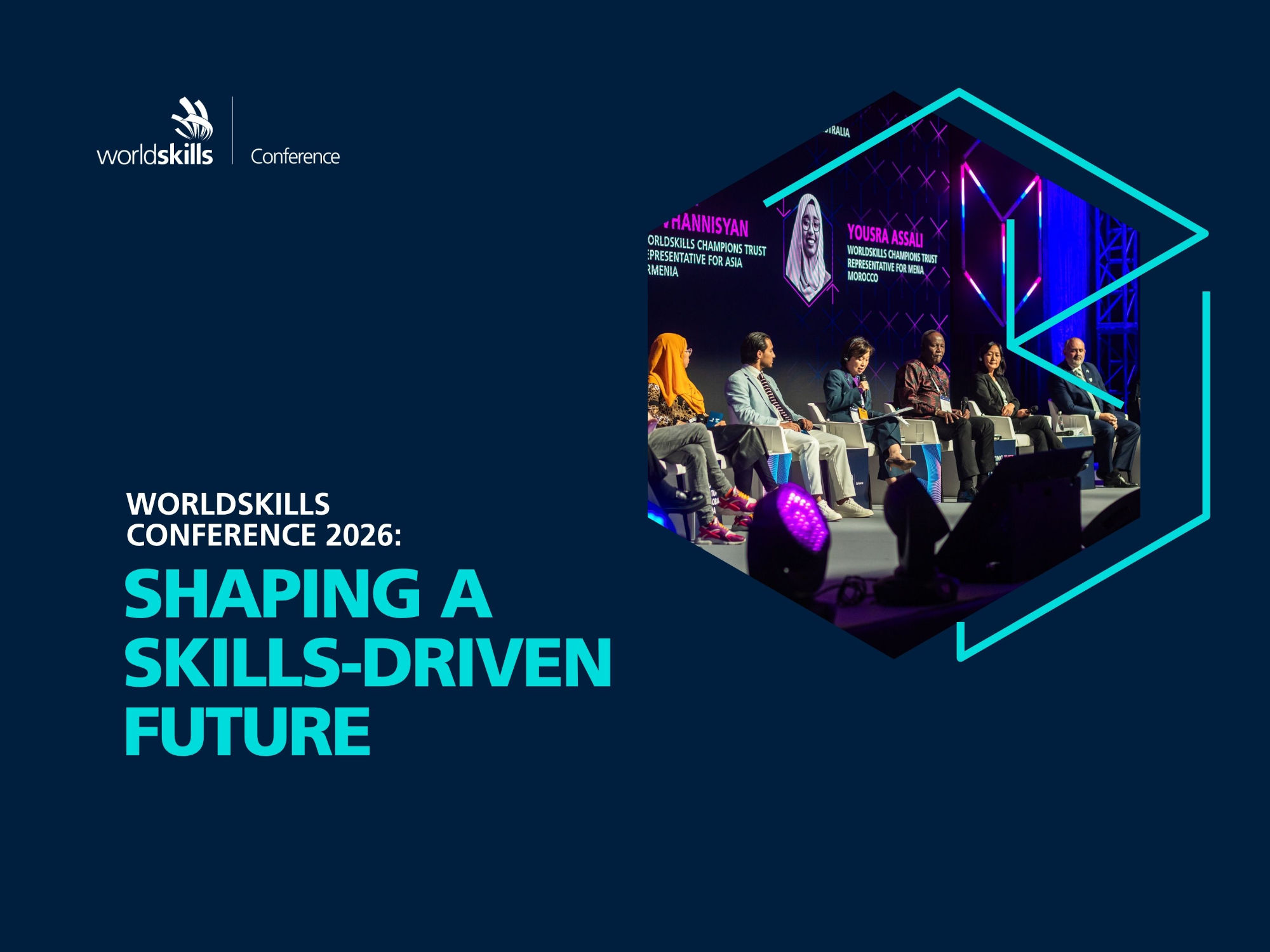
Skills policy is about far more than jobs: it creates opportunities, reduces inequality, and gives young people dignity and purpose. With technology rapidly reshaping industries, shifting labour markets, and a pressing need for growth that is both sustainable and equitable, how can skills systems be built to be both inclusive and based on excellence, without compromising on either?
Positioned as one of the most influential events in the skills development landscape, discussions at WorldSkills Conference 2026 will address this and other important questions, examining the intersections between inclusion, innovation, and cooperation in skills development. Against the backdrop of thousands of young skilled people competing at WorldSkills Shanghai 2026, policy makers, practitioners, industry, and youth will come together for three days of discussion centred on shaping a skills-driven future – one where young people around the world can unlock their full potential.
“Industries worldwide are developing faster every year: new technologies, innovations, AI. Even though young people learn and adapt quickly, keeping up with this pace has become harder, and prioritizing mental health while still providing peak performance has become more challenging than ever,” says Leyla Valiyeva, WorldSkills Champions Trust representative for MENA, arguing that the right support and guidance can help industries grow in a sustainable way.
Ms Valiyeva will represent youth at the Conference’s Opening plenary, a session that will look into new ways to future-proof systems, not only for industry and the market but also for human and environmental wellbeing. Shining a spotlight on youth voices, the Conference will put their concerns for the future of work at the centre and ensure their perspectives shape global skills solutions.
“Sharing the youth perspective is crucial to create the complete image of how the innovation systems should be curated going forward,” she says. “Young people are the future. Industries should strive to work together with them, instead of trying to shape youth according to outdated standards.”
Ms Valiyeva will share the stage with senior leaders from Festo Didactic, the ILO, the European Commission, and Neutech, with the panel moderated by journalist Nozipho Tshabalala.
The afternoon of the first day shifts focus to inclusion and mobility, two forces reshaping how – and for whom – skills systems work.
Delving into the conditions that enable some students to reach high levels of performance, the session Excellence for all: building more inclusive TVET systems will examine how these insights can help bridge gaps in skills development globally. With an outstanding panel including TVET institutions, global partners, and high-level policymakers, the audience will hear firsthand experiences from Ireland, India, and China on how high-quality skills development can be delivered so that it is accessible to all learners, particularly those facing structural disadvantage.
The session will be guided by Yousra Assali, former WorldSkills Champions Trust representative for MENA, who brings both lived experience as a WorldSkills Competitor and professional insight from her work advancing inclusion in skills development.
In parallel, the question of cross-border mobility will be addressed for the first time at a WorldSkills Conference. The session Beyond borders: Advancing frameworks for skills recognition will reflect on a wider move towards skills-first thinking, which is changing how skills are recognized, communicated, and rewarded across labour markets worldwide. Focusing on the skilled people who move, the economies that receive them, and the skills that deserve to be seen, the discussion will examine the architectures for skills recognition, the growing relevance of micro-credentials and private certifications, as well as successful examples of apprenticeship mobility.
Under the title “Shaping a skills-driven future,” inclusion is one of the three thematic threads of WorldSkills Conference 2026, alongside innovation and international cooperation. Taking place 23–25 September in Shanghai, China, WorldSkills Conference is more than a gathering, it is a call to action – empowering policy makers, industry, and education to share best practices and deliver skills solutions in a rapidly changing world and shape the United Nations post-2030 agenda.